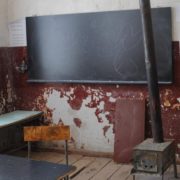
Heating in Georgian Schools
The provision of adequate, constant and quality heating has been a challenge for the Georgian education sector since the 1990s, when Georgia has lost its access to the central Soviet energy system, on which it was completely dependent, and had no money to develop its own infrastructure. This manifested in kids sitting in coats in schools, writing with frozen fingers and teachers collecting fuel from parents to use in rudimentary heating apparatuses in their classrooms.
The situation started to slowly change in 2000s with new investment into school infrastructure. However, most development was in the urban sector, and rural schools are still disadvantaged in terms of heating.
The salient issue that is still important in schools around the country is the widespread use of firewood as a source of heating. While this is mostly used in rural areas, some urban settlements also continue to use it.
All but three urban schools have central heating (there is a wooden central heating system as well), while rural schools have a more diverse system of heating and two in three rely on wood stoves, 90% of which are in bad condition (see figure below).
Only 15% of schools that used only wood stoves had some kind of central heating system, meaning that the rest, 85% or 816 schools, were able to heat only on a classroom-by-classroom basis.
Heating discussions, particularly about wooden stoves, loomed large in many focus group interviews at disadvantaged schools in rural areas, where a number of issues were laid out by school personnel and parents.
First, on windy days, smoke from the stoves gets in the classroom and beyond it being harmful, it makes it impossible to study on such days.
“Wooden stoves are an issue. When there’s a wind, it sends smoke into the rooms, and it’s bad for the students’ health and also the ash damages the furniture and the rooms themselves. Some time ago, they installed special knee-pipes [bent flues] outside against the wind, but it did not help”[1]
Since 2017, based on the Georgian government’s decision to fight climate change, many Georgian schools have started to use wood briquettes made out of wood waste to counter excessive logging in certain areas of Georgia. However, some schools in focus groups noted that briquettes were less efficient than their old-school beeches used for firewood.
The widespread use of wood for fuel is usually the simple result of the lack of gasification, since significant areas of rural Georgia remain unconnected to the gas network.[2] In areas where there is no central gas network, wooden or liquid fuel (central diesel heating) are the only options. However, in two focus groups, it turned that while the village had access to the central gas system, it had not reached the school. “Our neighbor has gas, but we still use the stoves.”[3]
The problem of tending the burning wood stoves is another issue. Some schools hire stokers for the fireplaces and workers to cut and carry wood daily into the school rooms, but in many cases, teachers have to do double duty of stoking the fire, and teacg at the same time. When teachers themselves have to manage fires means them coming in early to heat the stove and keep it safe and warm throughout the day.
“We have no stoker, if the stove dies, we need to bring firewood, light it up again and actually it’s not part of our jobs. Teachers are sooty, with tears in their eyes. It’s not suitable.”[4]
Devising appropriate heating systems for all schools, particularly in colder areas in mountainous parts of Georgia is key. For the villages where there already is a system of gas network, local or central government should make an immediate and concerted effort to connect these schools. For the villages with no planned gas system, central heating system with liquid fuel is a sensible solution.
[1] Focus Group with a public school
[2] GeoWel Research (2020), Educating Georgia: An Overview of Georgia’s General Education System and a Consideration of Opportunities and Challenges, p87
[3] Focus Group with a public school
[4] Focus Group with a public School