Key Findings
In 2004, Georgia embarked on an ambitious programme to reform all aspects of its education system, a root and branch effort to bring the country out of the outdated practices of the Soviet Union and the chaos, decay and corruption that pervaded education in the first decade after independence. These reforms focused not only on the physical rehabilitation of schools and on the provision of ICT infrastructure, but also on changing the culture of education that left large groups of pupils outside the mainstream, left behind by the educational system.
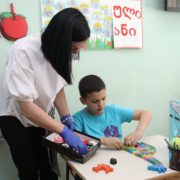
Most notable among the children who had been left behind by the educational system are children with Special Educational Needs (SEN) and children with disabilities. For decades education all but closed off to them. Many were not sent to school at all, and many of those that were sent to school were left adrift by a system incapable of responding to their needs.
More than fifteen years into the reform efforts and significant progress has been made. However, deep inequalities remain and the promise of inclusion for children with SEN and disabled children has yet to be fully realized.
More than two-thirds, 68%, of Georgia’s public schools educate children with SEN, employing around 2000 special education teachers. However, stigma remains deep-rooted and prevalent, varying on a school-by-school or class-by-class basis.
A major problem is human resources. In the groups assembled to assess needs, there might be one person responsible for an entire region of Georgia, equaling a couple of hundred children.
The qualification of special education teachers (as well as training of general education teachers) still lags behind desired levels. Often special teachers are general education teachers retrained in inclusive education, but such retraining is insufficient. In 2016 the State Audit Office examined the qualifications of 117 special education teachers across the country on a random basis. Out of the selected group 95% had academic education but only 44 of them – 38% – had received qualifications in inclusive education. The distribution of special education teachers per school and per student is also disproportional across regions.
Stigma among parents, who are at times unwilling to have their child assessed by a specialist, hinders diagnosis and inclusion. This is especially problematic in the regions. Most children with SEN tend to be from municipal centres, and very few from remote villages. This suggests that more active work is needed in hard-to-reach communities.
Lack of physical infrastructure and resources are also one of the factors hindering quality inclusive education for students with special education needs as well as for students with disabilities. While the official data show increasing trend in number of students with disabilities, reflecting increase in awareness and access as well indicates the state’s increased ability to provide inclusive education and decrease in stigma, the physical infrastructure available for wheelchair users, for instance, remains challenging.
According to the Ombudsman’s report, in 2019, out of 2084 school buildings only 120 were fully and 690 – partially adapted for the use of students with disabilities. According to a SAO report, in 2016 out of 233 schools who had students who use a wheelchair, 101 did not have a ramp, 143 did not have an adapted water closet, and 75 – neither of the two.
Blog | Georgia’s public school infrastructure – How inclusive?