The profile of car imports into Georgia can tell us a lot about consumer confidence. In particular, it seems to suggest that confidence was not as significantly affected by the war as one would think, and may now be recovering.
As Ford and General Motors discovered a year ago, car sales are an interesting weather-vane of consumer confidence because people can generally choose when to buy a car. As a result, a fall in consumer confidence is quickly reflected in car sales.
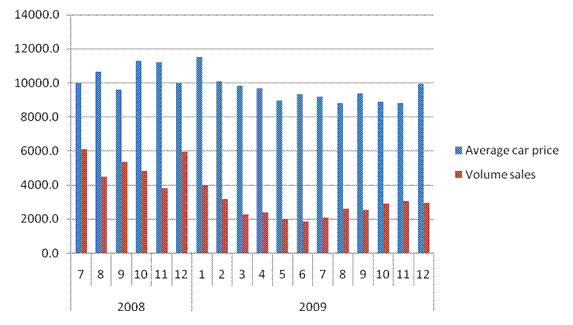
The Service Agency of the Ministry of Internal Affairs has just released a complete list of every car imported into Georgia since June 2008. The most obvious trend this reveals is, unsurprisingly, negative. In July 2008 6,115 cars were imported into Georgia and imports stayed between 4,000 and 6,000 cars per month for the rest of the year. By July 2009, it was 2074 cars or about 1/3 the level a year earlier.
Table 1: Import of Cars by Volume and Price Range for 2008 and 2009
Ref: All information in this article is based on information from the Ministry of Finance Website
While the decline is well known what is surprising is how late the decline really started. There is little indication that the war drastically reduced confidence amongst car buyers. The real collapse of car imports only really started in earnest in January 2009. Even accounting for a delay between purchase and arrival (as cars coming from the US can take 6 weeks to get here) this slump was too late to have resulted from the war.
One obvious explanation for the timing is the financial crisis, which became big news at the end of 2008. Another connected reason is that remittances into Georgia, according to the National Bank, continued to grow after the war and were pretty steady until January when they started to decline. Similarly, the financial crisis was not the only issue in the spring. The up-coming summer brought with it fear of another war and the protests further heightened political uncertainty.
The profile of imports can also tell us something about those who were most affected. Average price have been about $2,000 lower since the decline in sales. However, this hides the fact that while the mid-priced cars have weathered the recession pretty well, it is the extremes that have suffered.
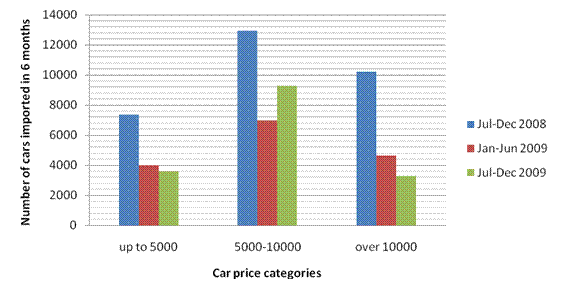
For the 18 month period we are covering about one quarter of cars were priced at USD 1,000 to USD 5,000, about half were priced at USD 5,000 to 10,000 and about one quarter were priced over 10,000.
Out of these three groups, both extremes were hurt far more than the center. If we compare the first and the third 6 month period, the cheapest cars lost around 51% of their sales, the top group lost 68% of their sales, but the middle group only lost 28% of their sales.
This is also reflected in the popularity of different brands. The Opel Astra, a low-price import which remains the most popular import into Georgia, lost 56% of its volume sales between the second half of 2008 and 2009. Similarly, the Opel Vectra (the fourth most popular car) lost 69%. At the other end of the spectrum, BMWs lost 63%.
The chart below shows the import volumes for the three price categories over the 18 month period.
Table 2: Import of Cars by Price range for the three 6 month periods
Ref: All information in this article is based on information from the Ministry of Finance Website
As one can see from the chart above, the one group of cars that has seen some recovery are those in the mid-price range. One practical result of this shift is that Japanese cars have done far better than German or American cars. While Germany has lost 57% of its volume sales, Japan has increased its sales by 20%, mainly supported by increased sales of Hondas and Subarus.
The one big Japanese exception to this rule is the Toyota RAV4. Long-favoured in Georgia, the RAV4 saw its imports drop by 67% between the second half of 2008 and the second half of 2009.
What is one to conclude from all this analysis? Perhaps that the BMW driver with the darkened windows, RAV4 driving Vake princess and the Opel cab-driver seem to have been hardest hit by this recession. Perhaps, that in times of recession, Japanese reliability trumps German glamour. Or perhaps, most significantly, that while the rich and the poor may still be suffering, a little optimism is at last seeping into the Georgian middle-classes.