Most countries in the world recognize the importance of education and provide compulsory school education to its citizens. Article 27 of the Constitution of Georgia states that “Everyone has the right to receive education and the right to choose the form of education they receive,” [paragraph 1] and that “Elementary and basic education shall be compulsory” [paragraph 2]. The basic importance of education lies in its possibility of personal and societal development, which, in turn, is linked to socio-economic development and equality. According to UNICEF, “education is a powerful tool for breaking the cycle of poverty; supporting child survival, growth, development and well-being; and closing the gap in social inequality.”
The main “job” of children ought to be studying and doing homework (along with the desired extracurricular activities) in order to prepare for their future adult life and profession.
Nevertheless, today, 250 million children aged between 5-12 cannot read, write or count. Some of them do not have access to schooling, while for many others, poor school infrastructure and a lack of qualified teachers mean that going to school does not really result in quality education.
Even with compulsory education and school infrastructure in place, in poor economies children or their parents often have to choose between the child’s education and the financial income that the child’s work might bring to the household. Georgia is no exception.
In 2015, some 5.8% (33.7 thousand) of Georgia’s school age children were employed or working, according to the . Of these 76.5% were boys. In addition, grand majority – 84.3% of the employed children represented rural settlements, mainly because of agriculture. In terms of regional breakdown, Guria had the highest share of employed children – 16.8%, followed by Samtskhe-Javakheti – 15.1%, Kakheti and Adjara – 12.7% and 10.6%, respectively. Tbilisi had the lowest child employment rate – 1.1%.
Children’s economic activity is classified as child labour if the work concerned “implies engagement of children in prohibited activities, which must be eliminated as socially and morally undesirable.” According to the same survey, 72.6% of working children or 24.4 thousand children working were engaged in child labour in 2015.
Figure 1. National Child Labour Survey 2015: Key Figures
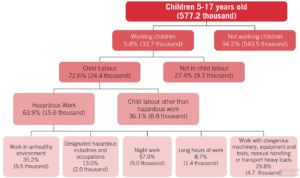
Reference: National Child Labour Survey in Georgia, 2015: Analytical Report, p6
Acquainting children with the meaning of hard work and specifics of family business or household chores is a positive thing (as long as it is not dangerous) as these skills last a lifetime, however, if it takes up too much time and energy from the children, deterring them from receiving compulsory education, benefits might underweight the risks. “Children were employed and if they had to work until late, they had hard time getting up the next morning and were unable to go to school,” – told as a teacher from Telavi municipality. But labour does not reflect solely on the class absence, as a teacher from Tsalka municipality has explained.
“A child who has been working in the field the entire day won’t be able to study in the evening, won’t be able to prepare [homework] properly. When the [seasonal agricultural] works begin, we notice regress [in level of education] and then again, we need communication with parents that ‘he’s a really good boy and maybe it’s possible that he helps you for less time’. Their parents are not financially well-off, so… Even if they go to school, it’s unproductive. A tired child won’t be able to prepare [lessons] properly. Both the motivation and interest are somewhere else.”
“Children’s employment was always a thing, mainly during non-school hours. It reflected on the quality of homework. [The children] have said to me in person, that they were unable to do homework because they were working.” – said a teacher from Bolnisi municipality.
According to the same 2015 survey, 90.7% of children in Georgia only studied and did not work, 5.2% (30.1 thousand) – worked and studied, 0.6% (3.5 thousand) children only worked and did not study, and 3.5% (20 thousand) – neither worked nor studied. So, in total 23 thousand children did not study at all in 2015. Majority of these children are enrolled in the education system but do not attend school. As of June 2021 the number of children left beyond education system in Georgia is . The causes need to be investigated by the government, and appropriate measures need to be taken in order to ensure every child in Georgia has access to rightful education.
The Ombudsman’s 2021 report on Child Labour states that “the leading factors, due to which children in Georgia are often engaged in labour, are poverty and inadequate standard of living.” The 2015 figures confirm this conclusion – with the increase in household income, the percentage of children engaged in labour decreased from 29.8% to just 8.5%, while school attendance increased from 93.0% to 98.0%.
Reference: National Child Labour Survey in Georgia, 2015: Analytical Report, pp 52,124
But besides helping the family in the field mostly in spring and autumn when sowing and harvesting season is on, some children have to go to greater length in order to help alleviate their financial situation. As one teacher from Guria has shared with us, there are multiple cases of underage children officially employed by private companies, working longer hours and conditions than permitted by the law.
“There are many kids on official payroll, working, especially in Poti. The so-called stoyanshiks[1] – usually these were older [men] but now children have replaced them. Also, there are fish processing mini-enterprises in Poti, employing many underage kids. Also, textile factories, Poti Textile, they hire children from tenth grade. They work until eight [in the evening] and they have to be at work at nine [in the morning].”
While some working students do not miss more than a day or two during each agricultural season, others, as the teacher from Guria, others education suffers considerably – firstly physically, as they have to work longer and/or harder than they are supposed to, but also mentally because their right to sleep, free time and leisure is limited. The Ombudsman’s report also highlights lack of parental awareness about the children’s needs and names it as a contributing factors of child labour: “Often parents do not have a proper understanding of what harm can be done to the child by being engaged in various heavy forms of labour, by imposing household labour on them during the time that should be spent on their education.” [p16]
“When they tell a kid, that I am going to give you a job, do not go to school, they think they’re doing a good thing. They forget that a child has a right to proper sleep, rest, play and so on. They do have a right to work, to help their mom and dad, but if they are employed somewhere, schoolwork suffers.” – said a teacher from Guria
With the COVID-19 pandemic having worsened the economic situation, many have completely lost or experienced decrease in household income, the consequences for education for some children has worsened. The families might need more involvement in family business, including agriculture, or might even migrate for economic purposes, as in these two cases shared with us by different teachers.
“My student, whose mother went [to work] to Greece and left three children here, to provide for them from abroad, lost her job there because of COVID. Now she stays in a small apartment of someone else, is unable to find a job there. And what does the child do? Milks cows in multiple farms, they remuenrate him in milk, he makes cheese with this milk, sells it on the street market and sends money [to his mom] to Greece.”
„We have siblings [students], mother took them by the hand and took them to Turkey, did not even warn the school. Possibly because of the economic situation worsened during COVID. Basically, they have not attended the academic year at all. They did not participate even though it [classes] was online. Possibly they [the children] also work too. What mechanism does a school have in this case, what can it do?! And what motivation can these children have [to study] when the parental attitude is this. Such kind of attitude is a demotivator.” – worries a teacher from Gori Municipality
Given the poor economic condition of the country, which is even stronger in rural areas, the schools threat these children with understanding as for many families involving children in labour and employment is ‘the means of survival’, as a teacher from Bolnisi municipality explained.
“Control by form teachers and principals is weakened, because it [children’s employment] is related to socio-economic problems. This community is not strong in this aspect, this is the default situation. So, it [child labour] is a means of survival. It is a dilemma to be strict and demand discipline [from children]. Socio-economic situation is so dire, that when [the children] show me their fingers, in what condition they are because they worked so much, it is difficult to demand strictly. They do not have other choice. I understand on a human level.”
To conclude, based on the available qualitative and quantitative data, child labour is a pressing, but understudied issue in Georgia. Children are involved in diverse labour activities, with varying degrees of hazard and labour code violations. The driving force of child labour in general and in Georgia as well is poverty. As a result, children have to sacrifice their rights – to education, health, psycho-social and physical development, rest and leisure. According to Ombudsman, state and municipal services in the field of child labour are scarce and insufficient. Therefore, the government, including the Ministry of Education and Science and the Ministry of Economy and Sustainable Development, as well as international and local stakeholders and organizations need to work closely firstly, on the up-to-date empirical and qualitative research, but also on ways of minimizing illegal child labour and monitor and ensure children’s rights are protected by providing relevant mechanisms.
[1] Stoyanka is the Russian word for a parking space. In Georgia, the term stoyanshik is used to denote a person that watches over cars parked in public spaces; the suffix –shik signifies a person in Russian. In other words, a stoyanshik is an informal parking attendant/guard. Stoyanshiki may be found in different parts of Georgia, but their activity is the most widespread in the capital city, Tbilisi.
Source: Stoyanshik (Georgia) by Lela Rekhviashvili, Doctoral school of Political Science, Public Policy and International Relations, Central European University, Hungary. https://www.in-formality.com/wiki/index.php?title=Stoyanshik_(Georgia) (Reviewed September 23, 2021)