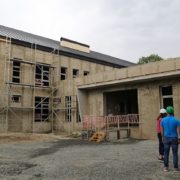
Infrastructure assessment of schools in 2018 and 2019 gave Georgian education policymakers a historic chance to devise a short-, medium- and long-term strategy for school renovation and building of new schools. We had granular knowledge of the physical state of each public school in Georgia as well as their FCI status, enrollment data and costs of urgent, medium- and long-term repairs.
As of now, this moment has come and gone. Georgian schools saw a great amount of spending on education from various sources since 2018, and they were not centralized in a particular strategic way.
Finding out detailed information on exactly how much Georgia spends on school infrastructure in a given year is extremely complicated, as financing comes from at least four different sources.
First, Education and Science Infrastructure Development (ESIDA), the main centralized government agency under the Ministry of Education generally responsible for the purchase and maintenance, spent had large spending recently: in years 2018-2021, it has built 38 new schools with a capacity of over 6,000 students worth GEL 98 million and performed 979 individual renovations that cost GEL 96 million. If we only take 2020 and 2021, period fully over the 2018-2019 assessment, numbers are, respectively, eight new schools worth 33 million and 55 million worth renovations.
At the same time, since 2018, ESIDA has given up some of its responsibilities to the Ministry of Regional Development and Infrastructure (MRDI), who have further deferred responsibility and funds to the Georgian municipalities. (other than the municipality of Tbilisi and Adjara Autonomous Republic), and transferred a total of 79 million to them in years 2019, 2020, and 2021 (in months January-August). However, in order to find out the details of this spending, one has to apply for information to every single of the 57 municipalities in question. None of the municipalities individually build new schools and this money is usually spent for small-time renovations. Additionally, starting in late 2019, Municipal Development Fund (MDF), government entity under MRDI, has also started school tenders on building new schools and some large renovations. In 2019, 2020, and 2021, it has spent a total of GEL 83 million building 39 new schools which could house 5,360 students, and repairing two village schools. MDF’s profile in this area is geared toward larger projects (planning and building new buildings) rather than renovations. Finally, there is an unknown (but likely smaller) number of school renovations that are financed privately by local or national sponsors. GeoWel has applied for information on the quantity and type of these private renovations, but ESIDA wrote that have such data is “outside the agency’s competence.”
Overall, if we check the period after the 2018-2019 assessment (either 2018 or 2019, depending on the school), analyzing sum total of all various sources suggest that from 2018, GEL 357 million was spent for renovations and building of new schools, and 77 new schools (38 through ESIDA and 39 through MDF) were built.
Out of these 77, just 7 new schools were in cities, where demand is highest, and 70 were in villages around the country. This was highlighted in conversation with experts, who noted that government’s decision to build new schools in areas where the population is not expected to grow was not based on rational action, but on political purposes. Of the schools built by MDF, 20 were standard 60-student village schools and another nine were 90-student, and ESIDA built 18 small 20-student schools.
Newer renovations and school development have not been audited and the quality of these works is unknown. In general, the overall strategy of the budget flow towards renovation of schools is often dictated by political interests rather than actual school needs. Focus groups have also revealed that in some cases, newer renovations of the heating systems have failed and school staff had to resort to old methods for heating. In one school, built in 2013, teachers reported that because the new central heating system can’t handle the winter cold and they now bring in their own electric heaters and said that they prefer the old school wooden system. Additionally, the material used to build walls in this particular school cracked and now this relatively new school has cracks in its outer walls. Such cases mean that auditing and thorough preparation before new development is key.
It is clear from the structure that there is no organized effort to refurbish and rebuild schools under a centralized plan based on school needs. It’s hard to imagine that ESIDA, MDF, each of 57 municipalities and private sponsors work under one plan according to renovation needs of the schools. This is unfortunate, as the 2018-2019 school evaluations could have been used as a benchmark to create an overarching refurbishment strategy from the initial point in time.
That said, it’s still not late. There are two ways to correct this organizational issue – one is to centralize all school refurbishment and rebuilding (ESIDA, MDF, MRDI/municipalities, private) under a cross-cutting agency, perhaps working under the Ministry of Education. This agency will ultimately make key decisions as to what to refurbish and rebuild first based on hard data. Another way is to out-source all refurbishment to municipalities, which would control schools and their refurbishment strategy in their area. It is logical that the former is short, and the latter a long-term optimal strategy.