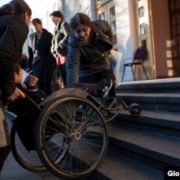
By working on inclusive education since 2004, Georgia has been making secondary education more accessible to students with special education needs (SEN) and disabilities. For a school to be considered “adapted” to meet the needs of disabled students, it has to have a ramp, an elevator, an adapted water closet, and classrooms and resource rooms adapted to the needs of the persons with disabilities and special educational needs. In addition, they need to be equipped with all that is needed for the children with sensory impairments, such as enhanced acoustics, Georgian sign language, braille system or similar technologies, for instance.
The information provided by Education Management Information System (EMIS) on the number of schools with students with disabilities include data for 2018-2020 only, showing an increasing number of students with disabilities enrolled in Georgia’s public schools: from 831 to 1246. This growth likely reflects an increase in awareness and access to education, as well as the state’s increased ability to provide inclusive education. Based on the available data, in this blog we mainly focus on public school infrastructure available for wheelchair users.
According to the Ombudsman’s report, in 2019, out of 2084 school buildings only 120, or 6%, were fully adapted and 690—a third – partially adapted. According to State Audit Office (SAO) report, in 2016 out of the 233 schools who had students who use a wheelchair, 101 did not have a ramp, 143 did not have an adapted water closet, and 75 neither of the two.
According to the infrastructure census of public schools conducted in 2018-2019, more than 73% of public school buildings in Georgia are not adapted to the needs of students who use wheelchair.
520, or 23%, of 2,233 school buildings had ramps, but of those only 20% were in good or fair condition, the rest were in a poor condition or substantially damaged. The same assessment data shows that only 22 schools had an elevator adapted for students with disabilities.
Figure 1. Condition of infrastructure for students with disabilities, 2019-2019
Reference: 2018-2019 public school infrastructure database provided by ESIDA. Data available publicly on our interactive map.
The data also show that only 323 schools – or 14% – had bathrooms adapted to students with disabilities. Of that number, 42% were in a poor or damaged condition.
Adapting only some components of physical infrastructure means that the students in need are unable to move freely across the school buildings, which is especially problematic in schools where several floors are used. 83% of the non-adapted schools are rural. While many rural schools tend to be small, enrolling just a few students, 392 rural schools with no disability adaptation have over 100 students, meaning that most likely they use several floors. While classrooms and resource rooms for wheelchair users are usually located on the ground floor, other rooms, including the library, cannot be accessed as there is no elevator. In addition, the thresholds in the doorways of classrooms create barriers for the independent movement of a wheelchair. According to the SAO report [p26], “the current situation poses a risk that students using wheelchairs will not be able to receive a proper school education, even though funds have been spent by the state to meet this condition.”
According to the 2018-2019 assessment data, urgent repair of damaged ramps and elevators and installing new ones are estimated to cost GEL 66 million – approximately 12% of the total urgent repair costs of the entire public school infrastructure budget, estimated at GEL 552 million. GEL 66 million is roughly GEL 30,000 per each of the 2,174 schools that require adaptability adjustments. Schools need to work closely with their municipalities and communities, including preschool, in order to plan the adaptation renovations and budgeting in advance of enrolling students who use wheelchair. Timely coordination of such information with Education and Science Infrastructure Development Agency (ESIDA) is required.
The blog was written as part of the Georgian Educational Advocacy Project, financed by the U.S. Embassy in Georgia. Any opinions expressed here are the views of the author and do not necessarily reflect the opinions of the U.S. government.