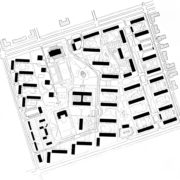
As we wrote in the previous blogs, about half of Tbilisi public schools are over their maximum capacity. Cumulatively, these schools have some 28,000 extra students. At the same time, other Tbilisi schools could take another 17,000 students. While there are still not nearly enough schools to accommodate all children in Tbilisi, there’s a large variation of enrollment in schools, because instead of walking to the closest school, many students cross the city via public transport to another public school with a better reputation.
There is no way of telling how many children in Tbilisi (and in Georgia) go to schools that are not close to them geographically. But there is circumstantial data on this: if we look at enrollment statistics across districts, the more central the district, the fuller its schools. As seen below, schools in the center of Tbilisi, in Mtatsminda district, are over 30% maximum capacity, while schools in the further away areas of Gldani and Krtsanisi can still take in students.
Moreover, if we look at population statistics – Mtatsminda has around 8,000 school-age children (numbers extrapolated to 2019 data from 2014 census), and 14,000 students. This means that the remaining 6,000 students come from other areas of Tbilisi. Conversely, Krtsanisi has around 6,000 school-age kids and only 2/3 of them, or 4,000 go to a local school. Both Gldani and Nadzaladevi, areas further out and poorer on average, have the same surplus: more school-age children than the actual number of students (7,000 more in Nadzaladevi and 5,000 in Gldani) – many of these 14,000 students have a long commute via public transport to a school in another Tbilisi district.
It is clear that the popularity and public perception of Tbilisi’s public schools varies dramatically. What kind of policies could undercut such disparity?
Soviet system of districting and its demise
From the 1950s the Soviet Union embraced modernism with its standardized, repeatable urban units, as its guiding path for urban development. Equality was a key ideological feature of socialist residential planning, vigorously expressed in Soviet housing estates through predefined and universal maximum (walking) distances to schools, bus stops, shops and parks. Everyone was, in theory, meant to have comparable access to comparable assets and amenities. (Hess and Metsepalu 2019) This also meant relatively rigid school districting: as a rule, every child went to one of the nearer public schools, which ought to have been no further than 700 meters from their home – an urban parameter for the maximum allowed walking distance for schoolchildren.
However, these rules were routinely subverted because of the perception that one public school was better than another. Since there were no private schools, people with more social capital wanted their children to go to the best public school in their town, even if it was in a far-off district. This was done through corruption, nepotism, ‘blat’, or similar strategies. After the fall of the Soviet Union, education policy related to redistricting began to liberalize, although the Law of Georgia on General Education (2005) and on “Education Quality Improvement” (2010) did retain the Soviet preference for school districting with the phrase “the State shall ensure the right of each pupil to acquire general education as close to his/her place of residence as possible”. However, these laws did not limit the parents’ choice of school and/or constrict them geographically. Firstly, the government introduced a voucher system, giving parents an opportunity to choose schools. Subsequently, since 2017, enrollment of students in school takes place through electronic registration. First, registration is open to students whose siblings attend their chosen school, whose parent/guardian is an employee of the chosen school, or from whose family two or more children enter the first grade at the same time. Then comes universal registration.
In effect, this means that first-grader registration in public schools is not based on geography, but (after the exceptions listed above) on a first-come, first-served basis. This leads to unintended consequences, such as first-graders’ parents and relatives around the country gathering around many computers on the midnight of school registration opening, to register quicker at the schools of their choice, in order to maximize their chance to get their kids enrolled. Often, many disadvantaged kids from the neighborhood whose parents lack relevant IT skills, cannot get into schools that are next door – its first grade gets full within minutes.
Districting pros and cons
According to urban planner Elena Darjania, districting serves four main purposes: child safety, efficient use of human resources for children, public transport optimization and strengthening of the neighborhood’s social capital. According to her, students are by and large safer during their travel to the nearest school rather than taking long rides to other city districts; second, they do not spend hours on public transport and aren’t are not too tired to do homework or perform other activities, and there is less toll on public transport, when kids, often accompanied by their guardians, putting more and pointed pressure on the public transport system. But there is also another, wider social policy aspect to districting.
“Finally, if we look at it from a larger policy perspective, school is a community center for the accumulation of local social capital. For example, school can be used in the summertime for local urban activities, sports halls and libraries can be used by the whole neighborhood,” Darjania noted in a conversation with GeoWel.
Critics of districting say that it restricts social mobility, tying children to “bad” schools that are near them. However, according to Darjania, this is looking at the problem from the wrong direction.
“Social mobility is an issue, but we must think of what for do we need it. The Ministry [of Education] should be responsible for every public school to have good teachers. Today, the outlook is that if you have a chance to take your kids to a better school you are free to do it, and what do you do with kids that don’t have such possibility? I’d say that strengthening the neighborhoods through strengthening the schools there should be the most important priority, and I don’t accept the premise that if you are a poor mother with many children struggling to make ends meet, your kids should have to stay in low-quality school.”
The problem is not only urban: the situation is even more dramatic when many children from villages around the country travel to the regional centers to schools. In these cases, the distance and time traveled is larger and safety for these kids is an even larger issue.
Beyond districting
Forcing all kids to schools of varying quality based on their geography alone is only part of the solution. It should come in one package with other relevant policies to strengthen schools in disadvantaged neighborhoods or villages.
“Strict districting is justified when all public schools are relatively similar in quality, when there is only a small difference. When we speak of the success of the Finnish public school model this is exactly what it entails, when there is no tragedy [for parents] if their kids go to different public schools as they know that they will receive the more or less the same thing,” said expert Simon Janashia.
This is clearly not the case in Tbilisi, where the quality of public schools varies significantly. According to Janashia, Georgian public policy should move towards districting, but only if the state works on equity programs to prioritize schools in neighborhoods where locals don’t have social resources (extracurricular activities, private tutoring) to do it themselves.
“If we know that in some areas people can’t provide resources themselves, e.g. if people in one neighborhood have a higher rate of education attainment than in others, schools in these other areas should provide more services. In such cases, there will be fewer mobility issues with districting,” said Janashia.
Indeed, strengthening schools in parallel with a soft redistricting policy could be key to addressing school urban inequality. But for that, the government should have a detailed understanding of the relative level of all urban schools.
What are the main parameters based on which the government (the local municipality or Ministry of Education) should rate their public schools? According to GeoWel, this informal index should have objective measurable components – infrastructure quality, number of afterschool programs, the share of qualified/lead teachers, transport data, scores at University Entrance Exams, but also a geographic component – the share of people from outside the 700-meter radius going to that school (a proxy way to measure popularity) as well as qualitative data to measure the reasons a given school is popular.
We will look at this index in the next section of this blog series.