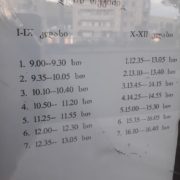
As we wrote in the previous blog, Tbilisi’s overcrowded school system uses two shifts to solve the problem of too many children per school. Around half of the schools in the capital have one part of the students study from 9 AM to 1 PM, and the next set of students start around 12-1 PM and end at 5 PM. (see illustration). What are the advantages and disadvantages of this system and how does it affect children going to these schools?

The two-shift solution was widely used in the Soviet Union as a temporary solution to overcrowding in growing cities with large industries. However, it was not seen as a long-term solution, as central urban planning also meant that enough schools were built to accommodate all students.
In Georgia, post-Soviet in-country migration has been mostly to Tbilisi. As we wrote in the previous blog, the capital added over 40,000 students in the last decade (in comparison, the rest of Georgia actually lost about a thousand students). Instead of building new schools to accommodate these students, increasing number of schools have started using two shifts: number of such public schools have doubled over five years from 2014 until 2019. (even prior to COVID-19 pandemic that forced many more schools to go two shift for health and safety concerns). The 2019 figure for two shifts in other urban areas is 18% – mostly Batumi and Rustavi. The system is not used in rural schools. Emphasizing the scale of the problem in the capital is the fact that eight of Tbilisi’s schools have three shifts. In 2019, 109,000, over two-thirds, of Tbilisi’s public school children study in schools with two shifts, while 53,000 are in one-shift schools.
Globally, two-shift systems are rarely used as a routine long-term solution to schooling. They are used as a temporary answer for dramatic growth in the population of a city, and are phased out when the city builds enough schools to accommodate everyone properly. Often, it is used in force majeure cases: Turkey and Jordan started implementing the double-shift system to accommodate the large influx of refugees and displaced people from the war in Syria in the last decade, and in Florida, two shifts were adopted on an emergency basis in cases of displacement due to natural disasters. It is also used in countries where lack of access to education is seen as the primary goal, in some countries in sub-Saharan Africa and Asia.
It is clear that having two shifts should is not ideal. With it, students tend to have less studying time in schools and are deprived of the extracurricular activity that is often planned for the afternoon. Having children at home the whole morning disrupts working parents’ lives and demands new solutions for caring for those children.
“The best practice is to lengthen time kids spend in schools. Many children are from lower-income families and don’t have the opportunity to receive additional services, and in these extra hours [in schools], they should have a wide range of opportunities – sports, club activities or individual work with teachers”, said expert Revaz Abkhazava in an interview. Obviously, two-shift schools can’t offer additional services due to the lack of time.
Moreover, according to the Ministry of Education regulation, the length of lessons for grades 2-12 is 45 minutes, generally, but two-shift schools can reduce the length to 40 minutes. However, as visible in the illustration, some schools, ostensibly to accommodate all the students, are forced to have 30-minute lessons. This regulation clearly leaves two-thirds of students in Tbilisi with less class time overall than their peers in one-shift schools.
At the same time, teachers often have to work double the time, which, according to education expert Simon Janashia, leads to fatigue and overwork.
“Teachers happen to take hours in both shifts, and this means that they often teach more hours weekly that they can handle. In such cases, the quality of education falls and having such a large amount of children [to teach] also has a bad effect on using different pedagogical methods. The teachers just can’t provide enough adequate care for this many children for that long,” Janashia told us in an interview.
While the sheer number of kids in Tbilisi leads to its schools having two shifts, the problem is exacerbated by the gap in quality between “good” and “bad public schools and the lack of school districting. Many children go to school across town via public transport, to a public school with a better reputation. Schoolchildren are not bound by their geographic location, which is why many schools in Tbilisi are more overcrowded than on average. Eight Tbilisi schools are over double their capacity. Other schools, deemed “bad” by parents living in the area, are underused in comparison. This leads to more school segregation within the public school system.
According to data collected in 2018 and 2019, 82 of 172 Tbilisi public schools are over their maximum capacity, and they cumulatively have 28,000 extra students, which represents 14% of all Tbilisi student body. Conversely, 60 Tbilisi schools that are underused could still take about 17 thousand extra students – but don’t because of the lack of demand. This leads to a situation where the schools with a better reputation, and likely better quality overall, use inferior two-shift system precisely because of their popularity.
Countries with similar political past, like Russia, have already started to phase out the two-shift system. School day expansion and eradicating two-shifts was seen as very successful for kids in South America: in Chile, this reform, undertaken between 1997 and 2010, led to increased educational attainment and earnings. In Tbilisi, however, such reform should also imply building new schools, but in the last decade, Tbilisi has built just three not considering old schools replaced with new buildings). Some schools started to apply for building permits to add space or floors around them. However, three new schools and a few extra floors and converted offices in existing schools is woefully insufficient: if we were to house the 28,000 “extra” students, Tbilisi would have to build 35 brand new average-size schools for 800 students (Tbilisi currently has 22 such typical schools), or 23 larger schools that could house 1200 students (Tbilisi has 25 such buildings). As a third option, Tbilisi could build 11 “mega” schools that house 2,500 students.
However, such huge projects cannot be the solution alone, as these new schools will start to get overcrowded because of increasing migration. In parallel to building new schools, the municipality/government could work towards redistributing some of the “extra” 28,000 children to the 17,000 places that are vacant in the 60 schools. In this way, the school system could more rationally educate the kids without extra strain on teachers in large schools. This can be done with redistricting and policies to improve services in the schools with bad reputation.
We covered the ideas of children redistribution around public schools and school districting and its pros and cons in the next blog.