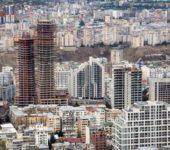
Georgian cities have been steadily growing in the last decades, but their school student population has been growing at an even faster rate: cities are becoming larger and younger year by year. For the last ten years, rural Georgians move to cities at an extremely quick rate, and this puts a particular strain on education
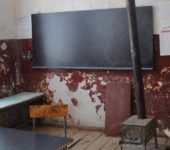
Heating in Georgian Schools The provision of adequate, constant and quality heating has been a challenge for the Georgian education sector since the 1990s, when Georgia has lost its access to the central Soviet energy system, on which it was completely dependent, and had no money to develop its own infrastructure. This manifested in
Teaching in Georgia suffers from a severe image problem. There is a perception of the profession having low salaries and teachers themselves having low prestige. This perception plays a role in stopping brighter and more motivated young people from becoming teachers. In spite of this image though, real remuneration for teachers has gone up considerably
Most countries in the world recognize the importance of education and provide compulsory school education to its citizens. Article 27 of the Constitution of Georgia states that “Everyone has the right to receive education and the right to choose the form of education they receive,” [paragraph 1] and that “Elementary and basic education shall be
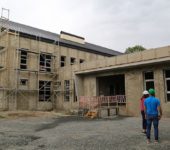
Infrastructure assessment of schools in 2018 and 2019 gave Georgian education policymakers a historic chance to devise a short-, medium- and long-term strategy for school renovation and building of new schools. We had granular knowledge of the physical state of each public school in Georgia as well as their FCI status, enrollment data and costs
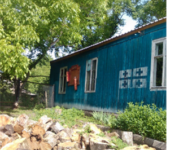
Georgia is a country proud of its tradition of inter-ethnic tolerance. Some 16% of the country’s population are ethnic minorities, mostly Armenians and Azerbaijanis, and government policy stresses the multi-ethnic, multi-cultural character of the Georgian state. According to Census 2014, Most of Georgia’s minorities live in rural, monoethnic settlements isolated from the rest of Georgian society, most obviously by language: 74% of native Azerbaijani speakers and 51% of native Armenian speakers do not speak Georgian fluently, which contributes to barriers existing for ethnic minorities in various aspects of public life, including public perception towards them.
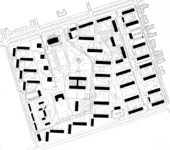
As we wrote in the previous blogs, about half of Tbilisi public schools are over their maximum capacity. Cumulatively, these schools have some 28,000 extra students. At the same time, other Tbilisi schools could take another 17,000 students. While there are still not nearly enough schools to accommodate all children in Tbilisi, there’s a large
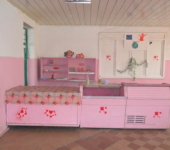
As we have attempted to document over this series of articles, the situation in the Georgian school system has seen tremendous improvements in recent years. But it has become apparent that there is one area where reforms have been seriously lacking, and where there is no clear plan to improve things: schoolchildren’s nutrition.
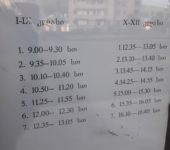
Tbilisi’s overcrowded school system uses two shifts to solve the problem of too many children per school. Around half of the schools in the capital have one part of the students study from 9 AM to 1 PM, and the next set of students start around 12-1 PM and end at 5 PM. (see illustration). What are the advantages and disadvantages of this system and how does it affect children going to these schools?
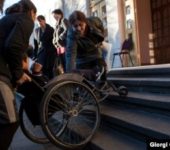
By working on inclusive education since 2004, Georgia has been making secondary education more accessible to students with special education needs (SEN) and disabilities. For a school to be considered “adapted” to meet the needs of disabled students, it has to have a ramp, an elevator, an adapted water closet, and classrooms and resource rooms