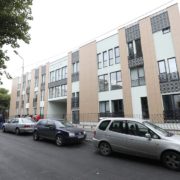
In-country migration in Georgia has led to considerable movement of people and especially younger people towards its capital, Tbilisi: it now has 40 thousand more students than ten years ago. Can the capital’s general school system accommodate these kids? Where do they go to study?
Georgia has been urbanizing rapidly through last hundred years, but the trend has been more marked in the last decade in particular – more and more people, especially young people, are moving to Tbilisi for jobs and opportunity: while it has around a third of Georgia’s population, it produces over half (51%) of its GDP.
The capital’s overall student population has been growing in a similar way: Tbilisi had around 171 thousand students in 2012, and has 212 thousand now, which is a remarkable 24 percent growth. One would think that this would lead to its municipality or other government organizations building new public schools for these students, but according to government statistics, the number of schools has actually slightly shrunk through the last decade: 291 in 2011 to 289 in 2021. This means that the average number of students in a single school has grown year to year (see chart below).
Currently, around half of public schools in Tbilisi are over 100% capacity, 10% are over 150% capacity, and eight schools are over double their maximum building capacity. However, the city has added just 2 new schools in the last decade.
Why won’t the city build new schools? According to urban planner, Shio Demetrashvili, it’s a combination of factors: non-existence of harder regulations for developers to build schools, lack of political will (bargaining power), and the lack of physical space with new school regulations.
“Municipality cannot bargain with the developers who build new blocks. The only thing they ask is to, at least, leave some open space within new development for the municipalities to build new schools and kindergartens in the future, but even that is often not complied with” – Demetrashvili says.
Currently, there are no regulations to compel the developers to build new schools or kindergartens around the buildings they build. There is one single case of such action, when a developer, Jikia House, has opened a private kindergarten at their condominium. However, according to Demetrashvili, having a private, and not public kindergarten (or school) is not a solution. Another issue is that development is very splintered.
“You can, as a municipality, maybe negotiate when one developer who builds the whole quarter, but when there is development and maybe ten firms build houses in the same area, it’s harder to compel and communicate with all of them” – says Demetrashvili.
The city officials are more responsive when it comes to kindergartens as they are under the municipality’s direct supervision, while schools are under the Ministry of Education. The ministry cites lack of space as the main reason for not building within the dense areas of the city (such as Vake and Saburtalo), where there is more overcrowding and new schools are needed the most.
Some schools have started to resort to renovation and expansion within their property. According to Demetrashvili, some popular and overpopulated schools now apply for building an additional floor on top of the existing building – however, this is often declined, as schools, by building regulations, can’t have more than four floors. In other cases, they build new buildings around their main one – which leads to more space for kids to study in but deprives them of open green space around the school.
City often can’t build brand new schools because of the new standards (since 2010) of authorization of schools, when it has to have classrooms equipped with proper inventory; gym, pool or playground, adapted environment for students with special educational needs. Also, schools can’t be close to a road with many cars and have to have a view of an open area. Currently, very few of the existing schools in Tbilisi comply with these regulations. “It’s almost like new schools have to have the whole small block for themselves with these standards”, Demetrashvili says.
Another option for the municipality is to buy out land and build new schools themselves – but the government’s policies, according to Demetrashvili, as of now is to sell, rather than buy land.
One way or another, the city will sooner or later have to address the issue of lack of schools and probably buy back the land it has sold. In-country migration to Tbilisi is not set to slow down or reverse, and the new high rises in its heart would need social infrastructure around them – be that schools, kindergartens, parks, or hospitals. Having government agencies dodging responsibility and burying their heads in the sand leaves Tbilisi’s ever-growing number of children behind.
The education ministry’s current solution to teach all these students is the two-shift system. Around half of schools in the capital have one part of students study from midday (around 12-1 PM) to late afternoon. Usually, these are older students who are more independent for mobility and generally. While this may be the lesser of the evils, it leads to a host of other issues, which we cover in the next part of the blog series on urban schools.